

Let’s be real: trying to scale a blog on a shoestring budget usually feels like bringing a knife to a gunfight. You’re competing against massive publishers with deep pockets, while you’re stuck doing everything manually.
I’ve been in those trenches, and the game changer isn’t always spending more money—it’s finding the right free AI automation tools for bloggers.
We aren’t talking about those glitchy, spammy text spinners that destroy your reputation. I’m focused on legitimate, no-code solutions that handle your social distribution, content outlines, and workflow efficiency for zero cost.
Whether you are a total beginner or a scrappy marketer looking to cut overhead, this stack is going to save you hours of grunt work every week. Let’s look at what actually works.
Why Use Free AI Automation Tools for Your Blog?
As a blogger, your most valuable asset is time. Juggling content creation, keyword research, SEO, and social media promotion can feel like a constant battle against the clock. This is where free AI automation tools become a game-changer. They aren’t here to replace your unique voice; they’re here to act as your personal assistant.
By handling the repetitive and time-consuming parts of blogging, these tools free you up to focus on what truly matters: creating high-quality, engaging content. Imagine automating your initial content research, optimizing an article for SEO in minutes, or scheduling a week’s worth of social media posts with just a few clicks. This efficiency doesn’t just save time—it boosts your productivity, helps you maintain a consistent publishing schedule, and ultimately drives more traffic to your blog, all without costing you a dime.
How We Chose the Best Free AI Tools for Blogging
Finding genuinely useful free tools can be overwhelming. To cut through the noise, we focused on a few key principles to ensure every tool on this list delivers real value. Our selection process wasn’t just about finding tools that were free; it was about finding tools that empower bloggers.
First, we prioritized tools that offer a robust “forever-free” plan, not just a limited-time trial. We then evaluated each tool’s core features to ensure they directly solve a common blogging problem, like writer’s block or SEO optimization. Finally, we considered ease of use. A tool is only helpful if you can integrate it into your workflow without a steep learning curve. Every tool recommended here has been chosen because it is powerful, user-friendly, and truly free.
Top 10 Free AI Automation Tools to Boost Your Blogging Workflow
| Tool Name | Primary Focus | Best For |
| Grammarly | Writing Assistant | Error-free writing |
| Copy.ai | Content Generation | Overcoming writer’s block |
| Jasper | Content Automation | Marketing teams |
| Byword | SEO Content Platform | Automated SEO articles |
| Writesonic | AI Search Visibility | Future-proofing SEO |
| AIOSEO | WordPress SEO Plugin | All WordPress users |
| Semrush | SEO & Marketing Suite | Deep competitor analysis |
| Wordtune | Rephrasing & Rewriting | Polishing written content |
| Surfer SEO | On-Page Optimization | Data-driven content |
| Hypotenuse AI | E-commerce Content | Bloggers with stores |
1. Grammarly

For bloggers, credibility is everything. Grammarly is an essential AI automation tool that acts as your final quality check before you hit publish. It goes beyond a simple spell-check, offering real-time suggestions to improve clarity, tone, and professionalism directly within your browser or writing app.
This tool helps ensure your message is communicated clearly and without distracting errors, which is crucial for building trust with your audience. Think of it as a quiet, reliable editor working by your side to polish every sentence.
Pros and Cons
Pros:
- Instantly corrects grammar and spelling mistakes.
- Provides suggestions for improving writing style.
- Works seamlessly across many different platforms.
- Helps maintain a consistent, professional tone.
Cons:
- Advanced suggestions require a premium subscription.
- Can sometimes miss complex contextual errors.
Best for: Bloggers who want to ensure every article is polished, professional, and free of errors before it reaches their audience.
Rating: An essential tool for all writers.
Pricing Plans: Grammarly offers a powerful free plan that covers all essential proofreading needs, with premium subscriptions available for more advanced features.
2. Copy.ai
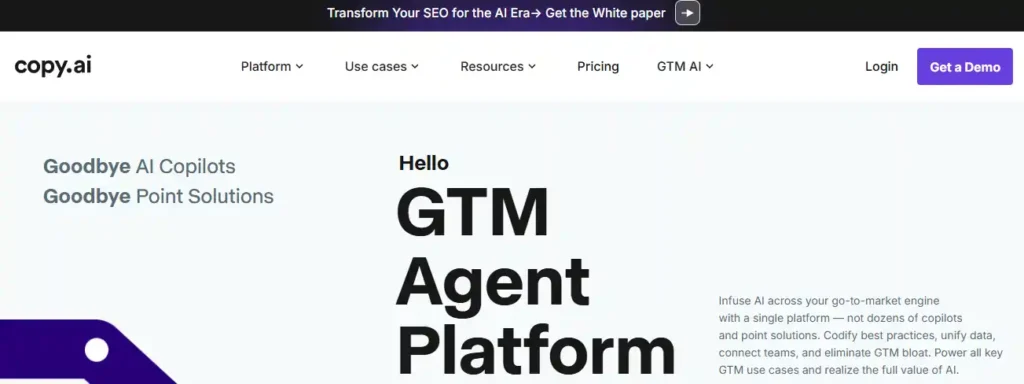
Writer’s block is a major hurdle for any blogger. Copy.ai is designed to be your creative partner, helping you move from a blank page to a full draft in minutes. It excels at generating a wide range of content, from blog post outlines and social media captions to full-length articles.
This tool is perfect for bloggers who need to produce a high volume of quality content quickly. By handling the initial brainstorming and drafting, Copy.ai allows you to focus your energy on refining and perfecting your message, ensuring a consistent and engaging publishing schedule.
Pros and Cons
Pros:
- Generates diverse content types quickly.
- Offers a wide array of templates.
- Helps overcome writer’s block effectively.
- Creates SEO-friendly content outlines.
Cons:
- Free version has credit limitations.
- Generated content always requires human editing.
Best for: Bloggers looking to automate their content drafting process and generate new ideas for articles, social media, and more.
Rating: A powerful tool for content scaling.
Pricing Plans: Copy.ai offers a free plan with unlimited chat and monthly workflow credits, making it a great starting point for bloggers.
3. Jasper
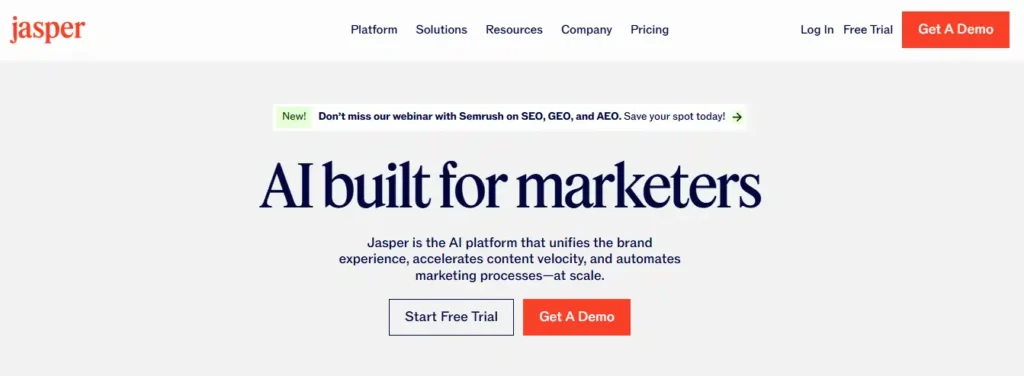
Keeping your blog’s content pipeline full is a challenge. Jasper is an advanced AI platform designed specifically for marketers and bloggers, automating the entire content lifecycle from idea to publication. It helps you scale content creation while maintaining a consistent brand voice.
Jasper acts as an intelligent partner, connecting your strategy with execution in a single, seamless flow. For bloggers who need to produce high-quality, on-brand content faster, Jasper provides the tools to automate workflows and accelerate output without sacrificing quality.
Pros and Cons
Pros:
- Automates the entire content lifecycle.
- Maintains a consistent brand voice.
- Designed specifically for marketing teams.
- Scales content creation for campaigns.
Cons:
- Primarily designed for teams and businesses.
- Free trial is limited in scope.
Best for: Professional bloggers and marketing teams looking to automate and scale their entire content strategy with a powerful, unified AI platform.
Rating: An advanced solution for serious content creators.
Pricing Plans: Jasper offers a free trial to explore its features, with comprehensive paid plans designed for teams and enterprise-level content automation needs.
4. Byword

For bloggers serious about ranking on Google, creating SEO-optimized content at scale is the ultimate goal. Byword is an all-in-one AI platform that automates the entire SEO content lifecycle, from keyword research to publishing. It’s engineered for marketers who need to produce high-ranking articles efficiently.
Byword functions as a complete content engine, analyzing top-ranking pages to generate articles with the right structure, headings, and keyword density to satisfy search intent. It even handles internal linking and contextual image generation, transforming a process that once took hours into a single click.
Pros and Cons
Pros:
- Fully automates the SEO content workflow.
- Generates articles designed to rank.
- Includes automatic internal linking features.
- Creates contextual images with alt text.
Cons:
- More focused on SEO than creative writing.
- The free trial is limited.
Best for: SEO specialists and bloggers who want to automate the technical aspects of content creation and publish articles at scale.
Rating: The ultimate platform for SEO-driven bloggers.
Pricing Plans: Byword offers a free trial to experience its features, with paid plans designed for serious marketers who need to scale their content production.
5. Writesonic
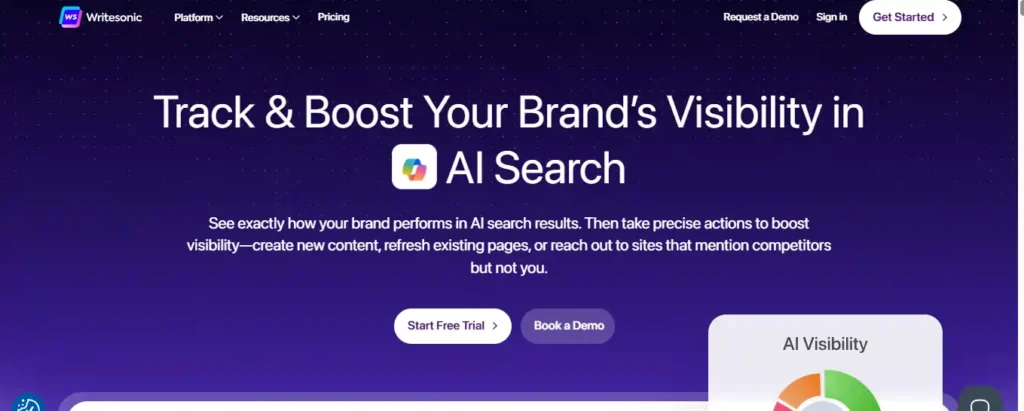
In the new era of AI search, simply writing good content isn’t enough. Writesonic is a forward-thinking platform that helps you track and boost your blog’s visibility directly within AI search results like ChatGPT and Gemini. It shows you where you stand against competitors and provides precise actions to improve your ranking.
This tool is designed for bloggers who want to future-proof their SEO strategy. It helps you create content that ranks on Google and gets cited by AI, fixing technical issues and identifying citation gaps along the way.
Pros and Cons
Pros:
- Tracks brand visibility in AI search.
- Creates content for Google and AI.
- Gives actionable steps to boost rankings.
- Identifies where competitors are mentioned.
Cons:
- Advanced features can be complex initially.
- Focus is heavily on AI search optimization.
Best for: Advanced bloggers and SEOs who want to optimize their content for visibility in both traditional and conversational AI search engines.
Rating: A must-have for future-focused SEO.
Pricing Plans: Writesonic offers a free trial that allows you to explore its powerful AI search tracking and content creation features.
6. AIOSEO

For bloggers using WordPress, optimizing your site for search engines can feel overly technical. AIOSEO is an all-in-one SEO plugin that simplifies this entire process directly within your dashboard. It makes powerful SEO features accessible to everyone, regardless of their technical skill level.
From an easy setup wizard to its detailed TruSEO on-page analysis, AIOSEO provides an actionable checklist to help you optimize every post and page. This tool automates complex tasks like XML sitemaps and schema markup, helping you improve your search rankings without ever leaving your website.
Pros and Cons
Pros:
- Simplifies complex SEO tasks for beginners.
- Provides actionable on-page SEO checklists.
- Automates internal linking and sitemap creation.
- Integrates seamlessly with WordPress and WooCommerce.
Cons:
- Only available for self-hosted WordPress sites.
- Many advanced features are in pro versions.
Best for: WordPress bloggers of all skill levels who want a simple, powerful, and integrated solution to improve their website’s SEO.
Rating: The #1 WordPress SEO plugin.
Pricing Plans: AIOSEO offers a powerful free version available on WordPress.org, with premium plans that unlock more advanced SEO and automation features.
7. Semrush

To truly grow your blog, you need to understand the entire competitive industry. Semrush is a powerful, data-driven marketing suite that gives bloggers a 360-degree view of their niche. It allows you to analyze your competitors’ strategies, discover high-value keywords, and audit your site’s technical health.
This platform is the gold standard for serious bloggers who want to make informed decisions based on real data. It helps you find exactly where your best growth opportunities are, from content gaps to backlink prospects.
Pros and Cons
Pros:
- Uncovers valuable competitor SEO strategies.
- Provides a massive keyword research database.
- Performs in-depth technical site audits.
- Tracks brand visibility in AI search.
Cons:
- Can be overwhelming for beginners.
- Full access requires a premium subscription.
Best for: Data-driven bloggers who want to perform deep competitor analysis and build a comprehensive, long-term SEO strategy to dominate their niche.
Rating: The industry standard for SEO data.
Pricing Plans: Semrush offers several powerful free tools and a free trial that provides limited-time access to its professional-grade subscription plans.
8. Wordtune

Finding the right words to express your ideas can be a daily challenge for any blogger. Wordtune is an AI-powered writing assistant that helps you rephrase and rewrite your sentences to ensure your message is clear, authentic, and engaging. It’s the perfect tool for refining your thoughts into polished prose.
Wordtune acts as a writing companion, offering context-based suggestions that match your unique style. Whether you need to switch from a casual to a formal tone or find a better way to phrase a complex idea, this tool empowers you to write with complete confidence.
Pros and Cons
Pros:
- Provides contextual rewrite and rephrase suggestions.
- Easily adjusts the tone of your writing.
- Advanced proofreading for grammar and spelling.
- Summarizes documents, articles, and even videos.
Cons:
- Focuses more on rewriting than initial creation.
- The free plan has daily usage limits.
Best for: Bloggers who want to improve the clarity, tone, and overall quality of their writing by refining sentences and exploring new ways to express themselves.
Rating: An excellent tool for polishing your writing.
Pricing Plans: Wordtune offers a generous free plan with no credit card required, along with premium plans for users who need more extensive features.
9. Surfer SEO

To win on search, you need to give Google and your readers exactly what they’re looking for. Surfer SEO is a content optimization platform that provides a data-driven workflow to ensure your content is visible in both traditional search and AI chats. It helps you create articles that are perfectly tuned to rank.
Surfer analyzes the top-ranking pages for your target keyword and provides a real-time “Content Score” as you write, giving you instant feedback on your on-page optimization. From structure and word count to keyword usage, Surfer gives you a clear roadmap to creating content that out-performs the competition.
Pros and Cons
Pros:
- Provides a real-time content optimization score.
- Identifies important terms and topics to include.
- Helps create ready-to-rank articles quickly.
- Automatically suggests internal linking opportunities.
Cons:
- Requires a subscription for full functionality.
- The data-heavy interface can be a lot for new users.
Best for: Bloggers and SEOs who want a scientific, data-driven approach to content creation and on-page optimization to consistently rank higher.
Rating: An essential tool for on-page SEO.
Pricing Plans: Surfer offers a range of subscription plans based on usage, with add-ons available for specific features like Surfer AI.
10. Hypotenuse AI

For bloggers who also run e-commerce stores, managing product descriptions and marketing content can be a massive undertaking. Hypotenuse AI is a specialized platform designed to automate the creation of on-brand, SEO-optimized content for both your blog and your products, helping you get to market faster.
This tool excels at generating everything from blog articles and ad copy to thousands of unique product descriptions in just a few clicks. It ensures your brand voice remains consistent across all channels, from your blog posts to your Instagram captions, making it a versatile content automation solution.
Pros and Cons
Pros:
- Generates blog articles and product descriptions.
- Creates content in a consistent brand voice.
- Optimizes content for SEO and conversions.
- Offers bulk generation for scaling content.
Cons:
- More specialized for e-commerce needs.
- The free trial is limited.
Best for: Bloggers who run e-commerce sites and need a unified solution to create SEO-optimized blog content and product descriptions at scale.
Rating: The top choice for e-commerce bloggers.
Pricing Plans: Hypotenuse AI offers a free trial to test its capabilities, with paid plans that provide comprehensive features for scaling your content creation.
How to Integrate These Free AI Automation Tools into Your Blogging Strategy
Adopting new tools can feel daunting, but the key is to start small and build a simple, effective workflow. Don’t try to use all ten tools at once. Instead, identify your biggest bottleneck—is it coming up with ideas, writing drafts, or promoting posts?
- Start with One Task: Choose one tool from the list that solves your most pressing problem. If you struggle with SEO, start with a free AI keyword research tool to guide your next article.
- Create a Simple “Stack”: Once you’re comfortable, combine two or three tools. For example, use an idea generator for your topic, a writing assistant to create the first draft, and a grammar checker to polish the final piece.
- Automate and Supervise: Use these tools to handle the heavy lifting, but always remember your role as the editor-in-chief. AI can generate a draft, but your personal experience, voice, and fact-checking are what will make the content stand out and build trust with your audience.
Frequently Asked Questions (FAQ) about Free AI Blogging Tools
Are free AI automation tools safe to use for my blog?
Yes, for the most part, reputable AI tools are safe. However, always be cautious. Stick to well-known providers and check their privacy policies. As a rule of thumb, avoid entering any private or sensitive information into a free AI tool. Use them for public-facing tasks like content creation and research.
Can I rank on Google using AI-generated content from these free tools?
You can, but with an important condition: the content must be high-quality and edited by a human. Google’s focus is on helpful, reliable, people-first content. Use AI to assist your research and drafting process, but always infuse the final article with your own expertise, experience, and unique perspective to ensure it provides real value to the reader. Pure, unedited AI content often lacks depth and can be flagged as unhelpful.
What are the limitatons of free AI tools for bloggers?
The most common limitations are usage caps (e.g., a certain number of words or queries per month), restricted access to advanced features, and more generic outputs compared to paid versions. Free tools are perfect for getting started and handling many basic tasks, but they may lack the deep analytical power or customization options that premium tools offer.
Final Thoughts on Using Free AI Automation Tools for Bloggers
Honestly, you don’t need a massive enterprise budget to compete effectively anymore. The free AI automation tools for bloggers we covered today prove that you can streamline your workflow without touching your wallet. From my experience building sites, the biggest mistake beginners make is trying to automate everything at once. Don’t do that.
Just grab one or two tools from this list—maybe for social scheduling or content drafting—and integrate them this week. You will feel the difference in your productivity almost immediately. If you found a tool I missed that is actually worth using, drop a comment below so we can test it out.